
What is Kindergarten all about anyways? How is Roots & Wings different from public Kindergarten? Should you keep your child(ren) in Montessori preschool or put them into public school or another private school? Last week Kristin gave a presentation on the Kindergarten year, to better inform parents on where to send their child(ren) when the time comes.
“Of all the years that I’ve taught, and I’ve taught from age three all the way up to age 16, my absolute favorite year is what we always used to call the extended day, the Kindergarten year. Because it’s the year when children flourish and us teachers get to see pings of inspiration as children solidify foundational skills.”
A Brief Overview of Montessori’s Four Planes of Development
Humans develop in four stages, each with 3 years of vulnerability followed by 3 years of strength:
0-3 years: Physically and biologically dependent.
3-6 years: Becoming independent (focus of kindergarten).
6-9 years: Mentally dependent, need support.
9-12 years: Leadership and independence.
12-15 years: Social vulnerability (adolescence).
15-18 years: Social independence.
18-21 years: Spiritual/moral vulnerability.
21-24 years: Becoming an adult.
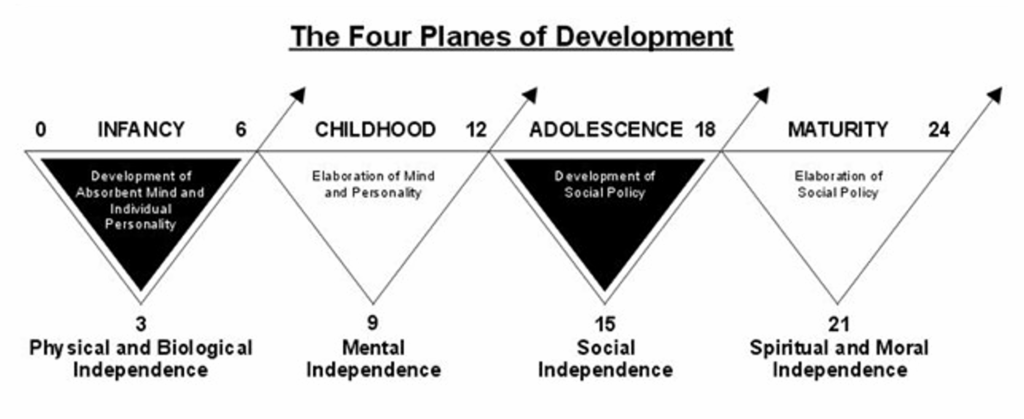
“Of course the one we’re focusing on is Montessori’s 3-year Preschool Cycle from ages 3 to 6. There’s a huge difference between a three-year-old and a six-year-old. As they progress, everything they experience in the classroom helps them become more independent, more confident. They gain a lot of self-esteem and are stimulated to do more by watching the older children.”
Kindergarten Year: The "Asparagus Year"
Kindergarten is the “asparagus year” as it is analogous to 3-year cycle of asparagus growth:
- Year 1 (age 3): Roots are put down (foundation skills).
- Year 2 (age 4-5): Strengthening roots.
- Year 3 (age 5-6): Growth bursts forth (reading, writing, leadership).
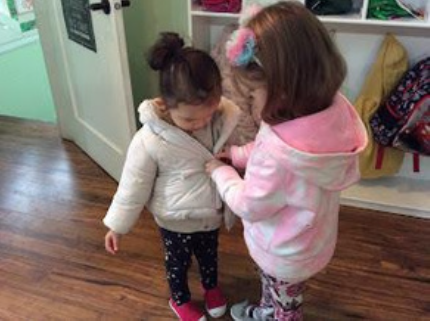
Kindergarten is a leadership year where children learn generosity and caring. Montessori’s mixed-age grouping is not accidental. The 3rd-year children are role models whom the younger children look up to. The younger children are stimulated and motivated to work towards using more advanced materials. The older children internalize knowledge by explaining materials to their younger friends; this builds confidence and self-esteem that they carry for all future learning. The most effective way to consolidate learning is to teach another.
The Kindergarten year contains many key developments, when abstract concepts click.
“When we notice a child finally experiences an ‘aha’ moment, that’s when we look at the other teacher and say, ‘There it is!’. There are a lot of moments like that with the five-year-old level.”
“Concrete to Abstract”
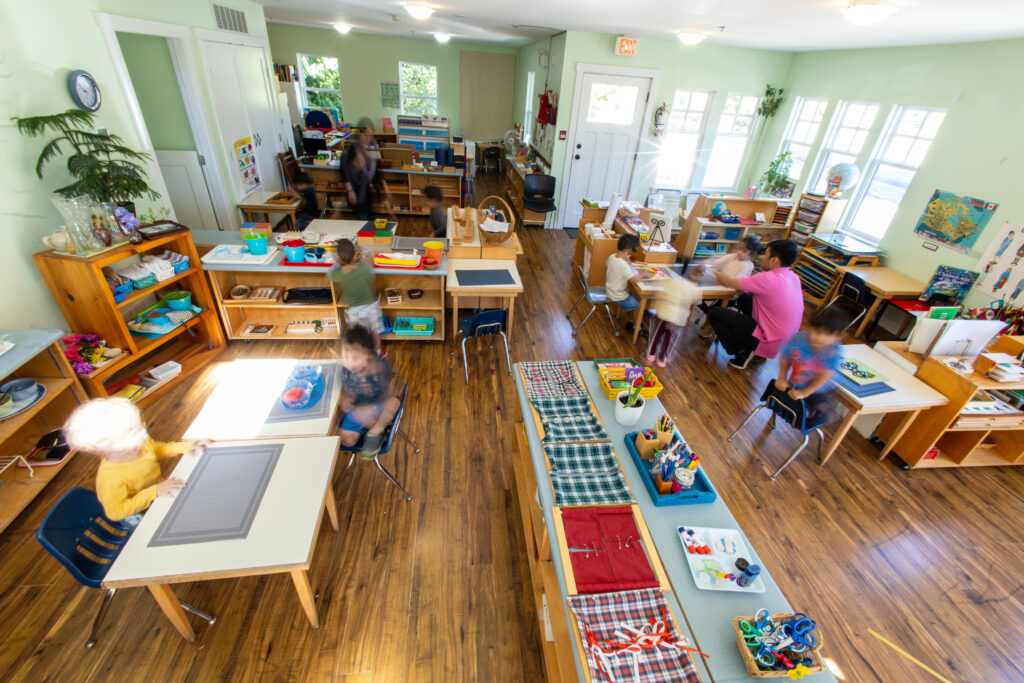
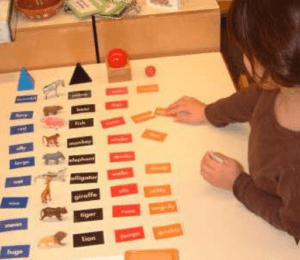
Montessori’s Theory highlights the progression from concrete to abstract thinking by first engaging children in hands-on experiences with real objects before introducing more abstract ideas. This “Concrete to Abstract” principle is central to the Montessori approach, shaping the way learning evolves from direct, tangible interaction to conceptual understanding. By using physical objects to understand numbers, shapes and sounds, children gradually learn to recognize these concepts in symbolic forms.
Children who arrive at public school and are asked to learn all these numbers and figures and rules, if they haven’t had this concrete work previously, they can’t go from the concrete to the abstract. They’re starting right at the abstract, and it can be confusing.
Montessori materials serve as “materialized abstractions,” meaning they are tangible representations of abstract concepts. These tools enable young children to explore pre-algebraic ideas through concrete objects such as number squares and cubes.
“Abstraction is an inner illumination, if the light doesn’t come on from within it doesn’t come on at all.”
– Maria Montessori
Fine Motor and Early Literacy Development
Activities include:
- Pin poking for fine motor control.
- Metal insets for design and muscle control.
- Sandpaper letters and advanced digraphs.
- Movable alphabet for early reading and sentence formation.
- Writing practice progresses from single letters to full journal entries. (All of our 3rd-year students learn to write in cursive!)
- Grammar is introduced early (nouns, verbs, adjectives, adverbs) to enhance creative writing.
Math Development
Concepts introduced gradually:
- Units, tens, hundreds, thousands.
- “Bring Me Game” to identify quantities.
- Bird’s-eye view of numbers up to 10,000.
- Bead chains for linear number sense.
- Addition, subtraction, multiplication, division boards.
- Binomial and Trinomial Cubes which introduce advanced algebraic concepts (e.g., A + B + C cubed).
- Geometry basics, including triangles and geometric solids.
“At the five-year-old level, they’re putting labels on everything. And they start to make booklets out of everything. And money. They need financial education, which is sadly missing in a lot of schools, but last year we had an entrepreneur show where our five-year-olds made, created products and sold them at our, at our annual Spring Fling.”
Other Academic and Practical Skills
- Labeling body parts, maps, and flags.
- Reading recipes and learning measurements and fractions through cooking and baking in our lunch program.
- Timeline of life and history introduced through eras (Azoic, Proterozoic, Paleozoic, Mesozoic, Cenozoic, Neozoic).
- Social and emotional development
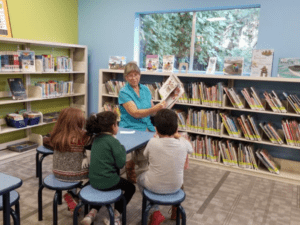
- Outdoor learning through regular walks and field trips (library, barn, skating, swimming, aquarium).
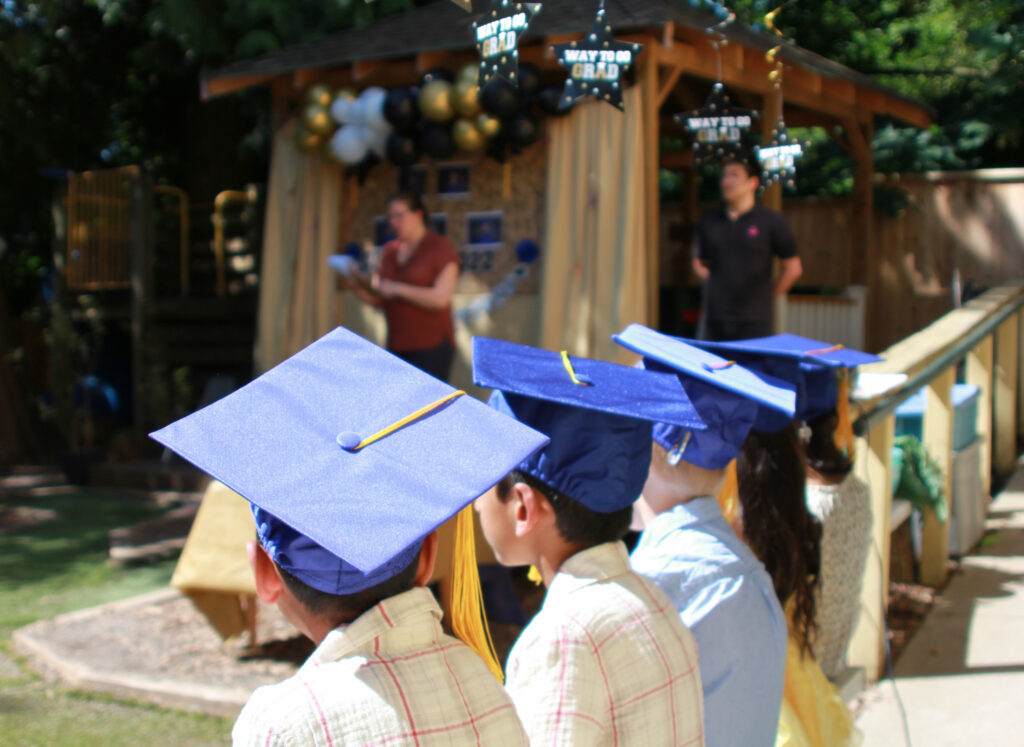
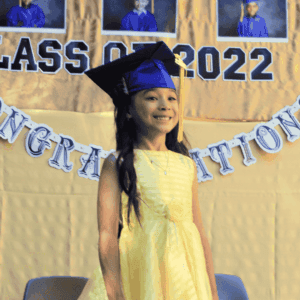
- A Graduation ceremony celebrates their achievements and growth.
Considerations for your child's Kindergarten year:
The Kindergarten year offers rich, varied experiences including academics, practical life skills, and outdoor activities, solidifying the foundation for independence, academic skills, leadership, and social development, providing a bridge from concrete learning to abstract thinking.
Now that you know about the Montessori curriculum and what the Kindergarten year looks like at Roots & Wings, you can compare our approach with alternative programs in your community. Every family’s situation is unique, and there are thoughtful reasons behind any educational choice a parent makes.
- Some private schools can have long waiting lists and recommend enrolling in the Kindergarten year to ensure a spot for grade one.
- Public Kindergarten is subsidized – if we could do it for free we would! However, we encourage parents to see tuition as an investment in your child’s foundation for their later years, turning roots into wings!
At Roots & Wings, we strongly believe in the value of completing the full three-year Montessori preschool cycle. The first two years lay the groundwork, and the third year allows children to strengthen their learning — developing confidence, independence, leadership, and a deep love of learning that supports them well beyond the classroom.
“At Roots & Wings, confidence and self-esteem are our most notable exports!”


Are you looking for a Montessori school for your child? Download our handy checklist for reference during your next preschool tour: What to Look for In a Montessori Preschool.
Want to learn more? Contact us today for a tour!